Why Compressed Air Quality Has Never Mattered More
In pharmaceutical manufacturing, a single moisture event in the compressed air supply can contaminate an entire production batch, triggering recalls that cost millions. In the semiconductor sector, airborne particles measured in nanometres can render a wafer useless before it ever reaches the packaging stage. And in food and beverage plants worldwide, ISO 8573-1 Class 1 air quality is no longer a differentiator — it is the minimum acceptable standard.
The economic stakes have never been higher, and neither has the engineering opportunity. The global compressed air treatment market is projected to surpass USD 18 billion by 2029, growing at a compound annual rate of 6.4%. The technologies emerging from that investment are reshaping how plants approach moisture removal, contamination control, and energy optimisation.
$18B
Global Market Size by 2029
6%
Projected CAGR (2024–2029)
30%
Energy Saved with Smart Controls
Refrigerated Drying: The Smart Revolution
Refrigerated air dryers remain the workhorses of compressed air systems across virtually every industry. Their operational simplicity, reliable pressure dew points in the +3°C range, and relatively low capital cost have made them ubiquitous. But the category is undergoing a quiet revolution driven by three forces: the HFC phase-down under the Kigali Amendment, the rise of inverter-driven variable speed compressors, and the integration of IoT-enabled monitoring platforms.
Next-generation refrigerated dryers — including EPSEA’s own high-temperature series — now employ R-290 (propane) and R-32 refrigerants, which carry global warming potentials of just 3 and 675 respectively, compared to R-404A’s staggering 3,922 GWP. The transition reduces both regulatory exposure and long-term operating costs.
Key Refrigerant Transition Milestone
Under the EU F-Gas Regulation and aligned global frameworks, refrigerants with a GWP above 150 are banned in new equipment from 2025 onward in several major markets. EPSEA’s full refrigerated dryer range achieved full compliance 18 months ahead of schedule.
Variable Cycle Technology: Matching Load to Energy
Perhaps the most impactful recent development in refrigerated drying is variable cycle control. Traditional fixed-speed dryers operate at full power regardless of the actual moisture load being processed — a fundamental inefficiency that wastes energy during low-demand periods. EPSEA’s VCC Series monitors inlet conditions in real time and modulates refrigerant circulation to match actual load, achieving energy savings of 35–45% compared to fixed-cycle counterparts.
“We’ve seen plants cut their compressed air treatment energy bill by over 40% simply by switching from a legacy fixed-cycle dryer to a variable-cycle unit with intelligent moisture-load tracking. The ROI is typically under 18 months.”
— Dr. Wei Linghao, R&D Director, EPSEA Industrial
Desiccant Drying: Ultra-Low Dew Points and Energy Recovery
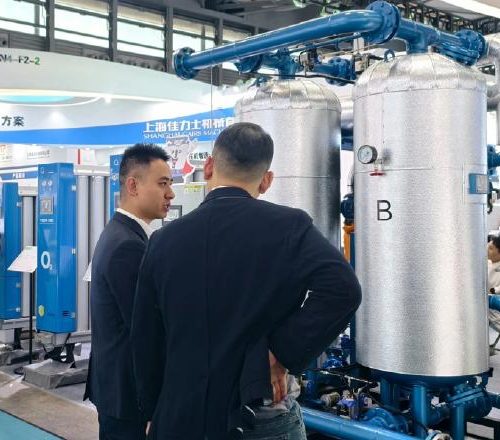
When applications demand pressure dew points below −20°C — cryogenic storage, instrument air in power plants, medical oxygen systems, and outdoor pipelines in sub-zero climates — desiccant technology remains irreplaceable. The question has never been whether desiccant dryers work; it has always been how to make them work without consuming enormous volumes of purge air.
Modern heatless desiccant dryers from leading manufacturers sacrifice up to 15–20% of compressed air output as purge. Heat-regenerated and blower-purge designs dramatically reduce that penalty. EPSEA’s blower-purge desiccant series reduces purge losses to below 1%, and when fitted with intelligent dew point control (the unit only regenerates when the desiccant bed actually needs it, not on a fixed timer), net energy consumption drops another 20–30%.
Desiccant Drying: Ultra-Low Dew Points and Energy Recovery
When applications demand pressure dew points below −20°C — cryogenic storage, instrument air in power plants, medical oxygen systems, and outdoor pipelines in sub-zero climates — desiccant technology remains irreplaceable. The question has never been whether desiccant dryers work; it has always been how to make them work without consuming enormous volumes of purge air.
Modern heatless desiccant dryers from leading manufacturers sacrifice up to 15–20% of compressed air output as purge. Heat-regenerated and blower-purge designs dramatically reduce that penalty. EPSEA’s blower-purge desiccant series reduces purge losses to below 1%, and when fitted with intelligent dew point control (the unit only regenerates when the desiccant bed actually needs it, not on a fixed timer), net energy consumption drops another 20–30%.